

The Ultimate Guide to The Simpsons Backgrounds for Portraits
Stepping into Springfield means more than just turning yourself yellow—it’s about capturing the vibe of one of the most iconic art styles in TV history. The right background is the secret sauce for a perfect custom portrait. Choosing from the huge world of The Simpsons backgrounds isn’t just about filling space; it's what gives your artwork personality, context, and a story.
This guide is here to help you pick the perfect scene and turn your portrait idea into something you'll treasure forever.
Welcome to Springfield: A Guide to Your Perfect Portrait Background
The world of The Simpsons has been a cultural landmark since it first hit our screens on December 17, 1989. Its visual style is recognized all over the globe, and you can find tons of history on the show's incredible journey and impact. When it comes to your custom portrait, the background isn’t just an afterthought—it’s the stage where your story happens.
Think of it as the difference between a simple character drawing and a complete, meaningful scene ripped straight from an episode. The background provides the "why" for your portrait. A scene on that famous family couch tells a story of chaotic, lovable family life. A portrait set at Moe's Tavern? That screams friendship, good times, and maybe a little bit of mischief. The setting gives your artwork a specific mood and makes it deeply personal.
Your Vision, Brought to Life
Consider this your roadmap to all the creative possibilities. We’ll walk through how to choose from classic, pre-made locations or even design a completely custom scene from scratch. We're covering everything you need to know, including:
- Getting the show's visual style right so your choices feel authentic.
- Picking iconic locations that perfectly match the theme of your portrait.
- Working with our artists to bring a unique, personal background to life.
Whether you picture your family hanging out at a classic Springfield spot or in your own living room drawn in that unmistakable style, the goal is always the same. We want to help you create a portrait that feels like a real frame from the show—a piece of art you'll be proud to hang on your wall for years to come.
Understanding the Visual DNA of Springfield
Ever wonder what makes a Simpsons background so instantly recognizable? It’s not just one thing, but a whole artistic recipe—a visual DNA that brings Springfield to life. Getting a handle on these core ingredients will help you spot the cool details in our pre-made options and give you the right words to ask for a custom design that’s spot-on.
Think of the show's art style like a nostalgic comic strip that jumped off the page. Everything is designed to feel a little imperfect and familiar, giving it a hand-drawn charm that slick, digital art just can’t touch. This whole vibe is built on a few key pillars that all work together.
The Signature Color Palette
The colors of Springfield are lively, but they never scream at you. The artists use a palette of bold primary and secondary colors that are often a little bit muted or "off," almost like they've faded a bit over time. You’ll almost never see a pure, electric blue sky; instead, it's a softer, more toned-down shade that just feels like the show.
This whole approach makes sure the characters, with their bright yellow skin, always pop. The background is there to support the scene, not to steal the show.
A great background tells a story without saying a word. In Springfield, the slightly skewed buildings and muted colors create a world that is both wonderfully absurd and comfortably lived-in.
When you’re thinking about your own portrait, consider how this color philosophy can set the mood. Are you going for the warm, inviting tones of the Simpsons' living room? Or maybe the dingier, cooler palette of Moe's Tavern? Each choice tells a totally different story.
Bold Lines and Simple Shapes
Another key ingredient is the use of bold, black outlines on pretty much everything. These lines aren't perfectly straight or clean; they have a slight wobble and vary in thickness, which really drives home that hand-drawn, organic feel. It’s a style that actively avoids sharp, computer-perfect lines.
On top of that, the geometry of Springfield is kept simple. Buildings, furniture, and landscapes are all built from basic shapes. This strips away any visual clutter, letting the important details—and, of course, the characters—take center stage. This infographic really breaks down how the background, character, and story all click together to make a complete picture.
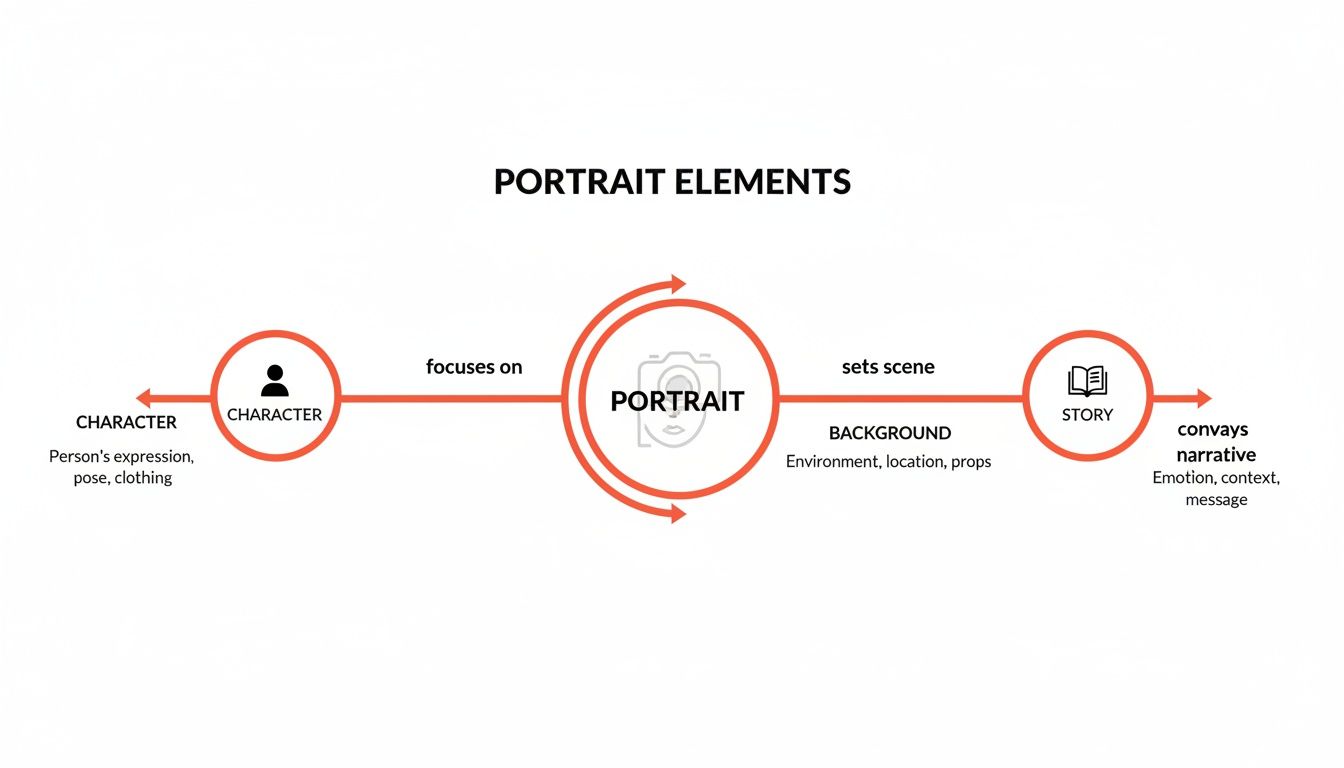
It shows that a great portrait isn't just about the person in it; it’s about how they interact with their surroundings to create a narrative.
A World with Wonky Perspective
Springfield is famous for playing fast and loose with the rules of perspective. Buildings might lean at weird angles, the horizon might be slightly curved, and the size of things is often exaggerated for a laugh. This isn't a mistake—it's a deliberate choice.
This "wonky" perspective is a huge part of the show's surreal, cartoonish atmosphere. It’s a visual cue to the audience not to take anything too seriously and creates a world that runs on its own logic. For your portrait, leaning into this element can add a layer of fun and authenticity.
Once you get these core principles, you’re in a much better position to explain your vision. You can go beyond just saying, "I want a Simpsons background," and start nailing down the exact mood, style, and details that will make your portrait truly special. This knowledge is the key to making sure your final piece feels like it was lifted straight from an episode, capturing the genuine spirit of the show you love.
Choosing Your Scene With Iconic Simpsons Backgrounds
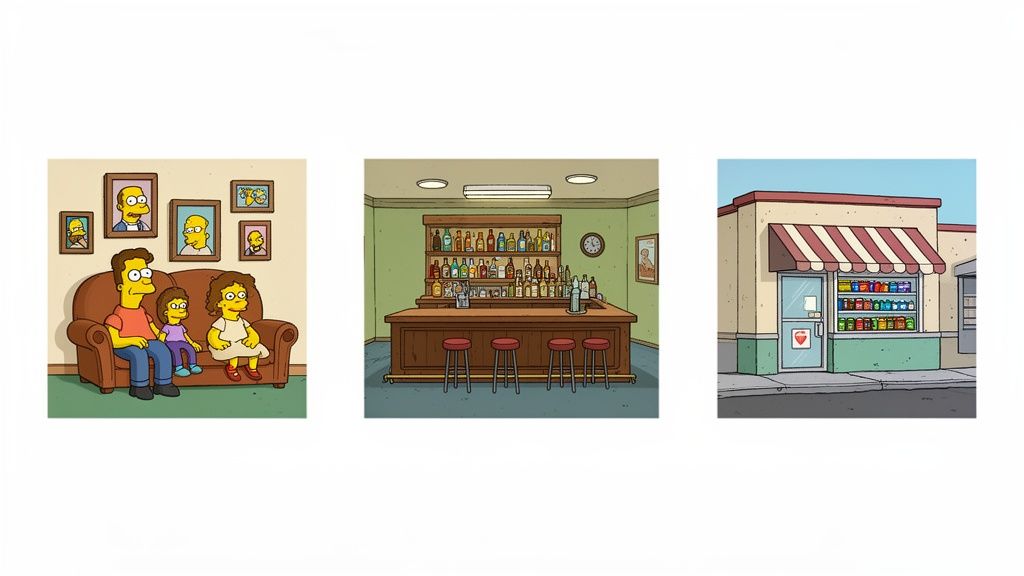
This is where the real fun begins. You've got the basics of Springfield's visual style down, and now it's time to drop your character into one of the show's legendary spots. Picking from the huge library of the simpsons backgrounds isn't just about finding a cool picture; it's like setting the stage for your own personal episode.
Think about it—the background you choose sets the entire mood. Are you going for a chaotic family vibe, a sweet moment between a couple, or an inside joke with your best friends? The right setting takes a fun drawing and turns it into a full-blown story.
To help you out, we've broken down some of the most famous and well-loved backgrounds. This way, you can easily match the vibe you're going for with a classic Springfield location.
Cozy Home Life at 742 Evergreen Terrace
The Simpsons' house is the heart of the whole series. It’s a place of comforting chaos, questionable parenting, and a whole lot of love. It’s the perfect setting for portraits that celebrate family, friendships, and the funny side of everyday life.
-
The Iconic Couch: Let's be honest, it's the most famous piece of furniture in television history. This is the go-to spot for a classic family portrait, capturing that perfect blend of love and dysfunction. It’s a fantastic choice for families, tight-knit friend groups, or couples who’ve spent countless nights binge-watching the show.
-
The Kitchen: This is where Marge works her culinary magic and Homer wages his endless war on the fridge. A kitchen background is great for couples, a hilarious Mother’s Day gift, or any portrait that celebrates home life with a wink and a smile.
-
The Backyard: From Bart's treehouse fortress to Homer's beloved hammock, the backyard is surprisingly versatile. It can feel like a nostalgic throwback to childhood adventures, a lazy Sunday afternoon, or a classic family barbecue.
Famous Springfield Hangouts
Springfield is buzzing with places where everyone gathers, making for scenes that are practically overflowing with personality. These spots are perfect for portraits with friends, coworkers, or for celebrating a big milestone together.
Your choice of background is more than just a backdrop; it’s a character in its own right. Moe’s Tavern doesn’t just look like a dive bar—it feels like decades of friendship, bad advice, and Duff beer.
Placing your portrait in a famous hangout instantly makes it feel like part of the show's world.
Iconic Landmarks and Businesses
Beyond the local joints, Springfield has landmarks that are recognized all over the globe. Each one comes loaded with its own unique brand of comedy and character.
-
Moe's Tavern: The quintessential dive bar. This is the perfect scene for a bachelor party portrait, a birthday shout-out for a friend, or for anyone who appreciates sharing a good laugh over a cold one. That dim, cluttered look is instantly recognizable.
-
Kwik-E-Mart: "Thank you, come again!" Apu's shop is the backdrop for all sorts of quick, quirky moments. It works really well for a funny, casual portrait of a couple or an individual who has a deep love for Squishees.
-
Springfield Nuclear Power Plant: The source of Homer's paycheck and most of the town's three-eyed fish. A portrait set here is a hilarious choice for a work friend, a boss with a good sense of humor, or anyone who can relate to the daily grind.
-
Springfield Elementary: From chalk-dusted classrooms to graffiti-covered lockers, the school is a great setting for portraits of kids, a gift for a teacher, or just a fun, nostalgic nod to your own school days.
If you're trying to figure out which famous spot fits your portrait best, this little guide should help you narrow it down.
Matching Your Portrait to an Iconic Simpsons Background
| Iconic Background | Best For (Occasion/Theme) | Characters/Group Size |
|---|---|---|
| The Couch | Classic family portrait, friend groups, anniversaries | 2-6+ people |
| Moe's Tavern | Birthdays, bachelor parties, friend group gifts | 1-5 people |
| Kwik-E-Mart | Casual couple portraits, funny individual gifts | 1-2 people |
| Nuclear Power Plant | Work colleague gifts, retirement, boss appreciation | 1-3 people |
| The Kitchen | Mother's Day, couples, housewarming gifts | 1-3 people |
| The Backyard | Father's Day, kids' portraits, casual family fun | 2-5 people |
Ultimately, the best Simpsons backgrounds are the ones that mean something to you. Whether you're capturing a family memory or cooking up a hilarious gift, picking a scene from our list is a fantastic place to start. And if you have a totally unique idea in mind, you can always create a completely custom portrait and bring any scene you can dream of to life.
Ditching Springfield: Let's Create a Fully Custom Background
While plopping yourself into one of Springfield's iconic spots is a ton of fun, nothing beats a background that's 100% you. This is your chance to step outside the show’s world and into a scene that tells your own story. Seriously, the sky's the limit here.
Imagine your family immortalized in that classic yellow style, but on your actual couch, in your living room. We can bring to life that unforgettable vacation spot, your old college dorm, the little coffee shop from your first date—even a wild, fantastical place born from an inside joke. This is how a cool portrait becomes a deeply personal keepsake.
Ordering a custom background is a team effort, and you're the most valuable player. To get the best results, you just need to know how to share your vision with us.
Sending Us the Perfect Reference Photos
Every great custom background starts with a good set of reference photos. Think of yourself as the set designer. The more visual clues you give our artists, the more life they can breathe into your chosen location.
Here’s a quick checklist for snapping effective reference pics:
- Get a Straight-On Shot: A photo taken from a direct, eye-level angle is almost always the best. This helps our artists understand the layout of the space without weird, confusing perspectives getting in the way.
- Let There Be Light: Shoot your pictures in a well-lit space. Dark or blurry photos can swallow up all the little details you want us to include. Natural daylight is your best friend.
- Capture the Big Picture: If you can, send one wide shot that shows the whole area you want drawn. This gives us a solid sense of scale and proportion.
- Zoom In on the Details: Back up that wide shot with close-ups of specific things that matter to you. This could be a favorite painting on the wall, a quirky lamp, the specific pattern on a rug, or that chaotic magnet collection on your fridge.
And don't stress about your photos being professional! Clear pictures from your phone are totally fine. The goal is just to give our illustrators all the visual puzzle pieces they need to build your scene in that authentic Simpsons style.
Describing Your Vision in Words
Your photos show us the "what," but your description tells us the "why" and "how." This is where you add the context, feeling, and specific directions that a picture just can't communicate. A good description helps our artists understand not just what to draw, but the mood you're going for.
Think of it like this: your reference photos are the script, but your written description is you, the director, giving notes to the actors. It’s the magic of both working together that creates a masterpiece.
When you write your description, try to be as specific as you can. Instead of just saying "our living room," give the artist more to work with. For example: "I'd like our living room in the evening, with the lamp on to create a cozy feel. Please make sure to include the blue vase on the mantelpiece and our dog's squeaky toy on the floor."
That little bit of extra detail makes all the difference.
Our Creative Team-Up
Creating custom Simpsons backgrounds is a true partnership. Once we have your photos and description, our artists get to work, translating your real-world space into the cartoon universe of Springfield. They’ll apply all the classic rules—the bold outlines, simplified shapes, and slightly wonky perspective—to make your scene feel like it jumped right out of the TV.
We’re not happy until you’re happy, which is why your feedback is a huge part of the process. You’ll get a proof of your artwork to look over. This is your chance to ask for tweaks and make sure every last detail is perfect before we call it done. Our commitment to unlimited revisions means we’ll keep refining it with you until you are 100% satisfied with your one-of-a-kind background.
Mastering Composition for a Picture-Perfect Portrait
Great art isn't just about what you draw; it's about how you arrange everything on the canvas. Composition is that secret ingredient that transforms a simple drawing into a scene that feels alive and pulls you in. Think of yourself as the director of your own mini-Simpsons episode. You get to decide where everyone stands, what they're doing, and how the background frames the action to tell the best story.
You don't need to be an art school grad to get the hang of this. By picking up a few simple ideas about character placement, focal points, and visual balance, you'll be able to make smarter creative choices. This helps you guide our artists toward a final portrait that looks polished, professional, and full of personality.
Finding the Focal Point
Every great picture has a focal point—it’s the main spot your eyes land on first. In a custom portrait, that's almost always going to be the people. The goal is to make sure your subjects stand out, even if they’re in front of a busy, detailed background.
One of the easiest tricks in the book is smart character placement. Try to avoid putting characters smack-dab in the center of the frame, which can feel a little stiff and predictable. Instead, give the Rule of Thirds a shot. Imagine your canvas is split into a 3x3 grid. Placing your main characters along those lines or where they cross creates a much more dynamic and balanced look.
For instance, putting a couple slightly to the left in front of Moe’s Tavern gives your eye a chance to take in the iconic setting before settling on them. It adds a wonderful sense of depth to the whole scene.
Just like in the show, the best scenes feel natural and full of movement. Good composition guides the viewer's eye through the artwork, creating a narrative flow that makes the portrait feel like a captured moment in time.
This one simple technique can instantly make your portrait feel more thoughtful and professional.
Creating Visual Balance and Flow
Balance is all about spreading out the "visual weight" in your portrait so one side doesn't feel heavier or more cluttered than the other. This doesn't mean you need perfect symmetry. In fact, asymmetrical balance often makes for a more energetic and interesting picture.
Let’s say you have a large group portrait set on the iconic Simpsons couch. You can create balance by putting a similar number of people on each side. If you have an odd number, you can use something in the background—like the crooked boat painting on the wall—to add a little visual weight to one side and even things out.
Here are a few quick tips for achieving great balance:
- Vary Character Poses: Nobody wants to see everyone standing stiffly in a line. Poses that show interaction—like one character leaning on another or pointing at something in the background—create a sense of connection and life.
- Use the Background to Your Advantage: Let your characters interact with their environment. Someone could be leaning against the Kwik-E-Mart counter or kicking back in Homer's chair at the nuclear plant.
- Consider Group Size: A bustling spot like Moe's Tavern can comfortably fit a small group of three or four without feeling crammed. For a larger family gathering, a simpler setting like the backyard might be a better fit.
Making Your Characters Pop
Finally, you want to make sure your characters are the undeniable stars of the show. Even with fantastic composition, a super-detailed background can sometimes fight for attention. Our artists have a few tricks up their sleeves for this, but your choices can make a big difference, too.
Posing characters in bright clothing against a darker or more muted background is a classic move that always works. On the flip side, if your custom background is really detailed (like a recreation of a cluttered garage), keeping the character poses a bit simpler can create a nice, clean contrast.
The goal is to find that perfect harmony between your characters and the Simpsons backgrounds you choose. By thinking like a director, you can help create a portrait that isn't just a collection of cool elements, but a cohesive and compelling piece of art. For more ideas on creating impactful artwork, check out our guide on how to use custom portraits for maximum impact.
Bringing Your Custom Portrait From Screen to Wall
So, you’ve signed off on the final proof. You've perfected the characters, picked out one of the best Simpsons backgrounds, and now you're holding a digital masterpiece. What's next? This is where the magic really happens—transforming that file on your screen into a physical piece of art you can actually hang on your wall.
Getting your portrait from screen to print is the final, crucial step. To make sure it looks just as amazing in your home as it does online, we need to touch on a few details. Don't worry, it's simpler than it sounds, and getting it right is the secret to a professional-quality print you'll be proud of for years.
Decoding Print Quality and Resolution
Ever tried printing a picture you found online, only for it to come out looking blurry and, well, blocky? That’s a classic resolution problem. Resolution is really just a term for how much detail is packed into an image, and it's measured in Dots Per Inch (DPI).
Think of it like building with LEGOs. A high-resolution image is made with thousands of tiny little bricks, creating a picture that's smooth and full of detail. A low-res image is like using those big, chunky DUPLO blocks—the end result is fuzzy and pixelated.
We deliver all our digital portraits at a high resolution of 300 DPI. This is the gold standard for professional printing, ensuring that whether you print a small photo for your desk or a giant poster for the living room, every line stays sharp and the colors pop.
This high-quality file means you can print with confidence, knowing your custom background and characters will look crisp and clear in the real world.
Choosing the Perfect Print Size and Shape
Next up is figuring out what size and shape you want. Your custom portrait will be created in a standard rectangular shape, or aspect ratio, which is just the relationship between the image's width and height. This makes it super easy to find a frame that fits.
When picking a size, think about where your new portrait is going to live.
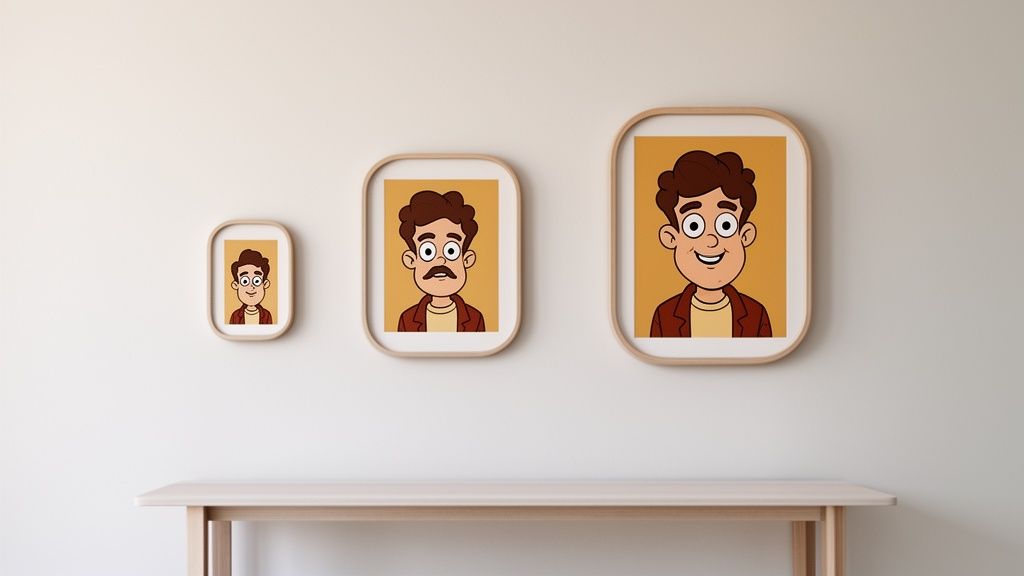
- Small Frames (5x7" or 8x10"): Perfect for a desk, bookshelf, or bedside table. They add a fun, personal touch to smaller nooks and make fantastic gifts.
- Medium Prints (12x16" or 16x20"): This is a really versatile size that looks great as part of a gallery wall or as a standalone piece in a hallway or home office. It’s big enough to make an impact without taking over the room.
- Large Statement Pieces (18x24" or larger): Want your portrait to be the star of the show? Go big! A large-format print is an instant conversation starter and looks incredible above a couch, in a dining area, or in an entryway.
Framing and Displaying Your Masterpiece
The frame is the final touch that pulls everything together. The right one not only protects your print but also helps it blend in with your home's decor.
A simple black or white frame is often the best choice, as it lets the colorful artwork and the detailed Simpsons background really shine without any distractions. If you're feeling a bit more playful, you could even pick a frame in a bold, primary color that's pulled from the artwork itself!
Once it's framed, your portrait is ready for its grand debut. Taking a moment to think about these printing and display details ensures your one-of-a-kind art is preserved beautifully. To learn more about keeping your artwork looking great, check out our tips for custom portrait longevity and preservation.
Got Questions About Simpsons Backgrounds? We've Got Answers.
Stepping into the world of custom art can feel like a new adventure, and it’s natural to have a few questions. We get it. To make things crystal clear, we’ve put together a list of the questions we hear most often about creating that perfect portrait with one of our iconic Simpsons backgrounds.
Our whole goal here is to make this process fun, easy, and totally transparent from the moment you have an idea to the second you unwrap your art.
Can I Mix and Match Elements From Different Backgrounds?
Heck yes, you can! In fact, that's one of the best ways to create a portrait that is 100% you.
Want to see the classic Simpsons couch sitting right outside Moe's Tavern? No problem. When you choose a custom background, just tell us what you're dreaming up. If you have reference photos for the different pieces, even better! Just describe what you want to merge in your order notes.
Our artists are pros at blending different scenes into a seamless new world for your characters. Be clear about your vision, and we'll handle the rest.
What Kind of Photos Should I Send for a Custom Background?
Great question. To get the best results, send us a few clear, well-lit photos of the location you want us to draw. Try to get a straight-on shot, as that usually gives us the best perspective to work from.
Most importantly, make sure to capture all the little details you want included. We're talking about that specific painting on the wall, the quirky lamp you love, or even the dog's favorite beat-up bed in the corner.
The more visual information you give our illustrators, the more life and personality they can pack into your one-of-a-kind Simpsons-style scene.
Will a Super Detailed Background Make My Characters Disappear?
This is a really smart question about composition, and it's something we've thought a lot about. Our professional artists are trained to perfectly balance the detail in the background with the characters in the foreground. They use clever tricks like slightly softening the background colors or using bold, clean outlines on your characters to make sure they pop right off the page.
Your characters are the stars of the show, and we make sure they stay that way. During the proofing process, we’ll work with you to ensure the final image feels perfectly balanced. The background is there to set the stage, not steal the spotlight.
This back-and-forth ensures your portrait looks exactly how you imagined it.
How Long Does a Custom Background Take?
Creating a totally custom background from your photos or ideas typically adds about 1-2 business days to our standard creation time. Of course, this can vary a bit based on how complex your request is. A simple landscape might be quicker than recreating a jam-packed living room with tons of specific objects.
We always put quality first, and we'll give you a clear timeline when you place your order. Plus, our unlimited revisions policy means we'll take all the time we need to get every single detail just right for you.
Ready to see your own unique world come to life in Springfield? The artists at Happy Tooned are excited to turn your vision into a piece of art you'll love forever. Start creating your custom portrait today!